The Ultimate Guide to Surface Protection: Wax, Sealants, Sprays, and Ceramic Coatings for SUVs and RVs
Comparing natural wax, polymer sealants, ceramic sprays, and professional ceramic coatings — durability, cost, and what’s best for your SUV or RV. Expert insights with local service perspectives from Eagle, Boise, and Meridian.
Protecting a vehicle’s paint is about more than just aesthetics; it’s about preserving the value of an investment. Whether you drive a daily-driver SUV or own a luxury Class A motorhome, the exterior faces a constant barrage of UV rays, road salt, bird droppings, and environmental contaminants. With the market flooded with protection options, choosing the right one can be overwhelming.
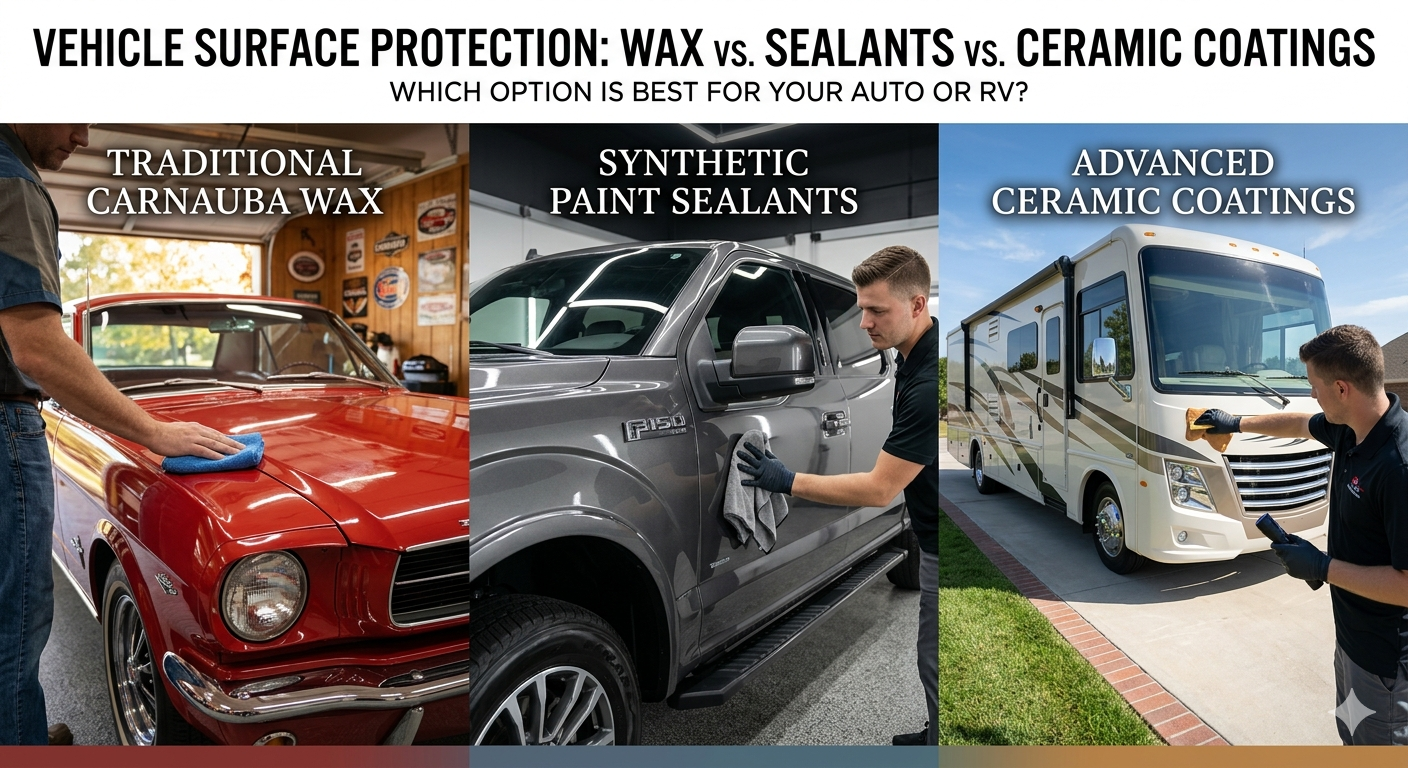
The primary contenders fall into four categories: traditional Carnauba or Montan wax, synthetic polymer-based sealants, versatile ceramic spray sealants, and professional-grade ceramic coatings. Each offers a distinct balance of cost, durability, application effort, and visual appeal. This guide will break down the pros and cons of each, compare their costs for vehicles ranging from a standard SUV to a 40-foot RV, and help you decide which solution best fits your lifestyle and budget.
1. Carnauba or Montan Wax: The Classic Shine
For decades, wax was the gold standard in paint protection. Derived from natural sources, waxes offer a depth of gloss that many enthusiasts still consider unmatched.
What They Are
Carnauba wax is harvested from the leaves of the Copernicia prunifera palm tree in Brazil. It is the hardest natural wax available, creating a rigid, crystalline layer on top of the paint. Montan wax, a fossilized plant wax derived from lignite (brown coal), is a less common alternative that offers similar hardness with a higher melting point, making it slightly more heat-resistant — an advantage for vehicles parked in scorching sun.
✅ Pros
- Aesthetic Excellence: Deep “wet look” glow, warm richness
- UV Protection: Solid barrier against oxidation and fading
- Accessibility: Straightforward hand application, classic DIY weekend project
❌ Cons
- Short Lifespan: Lasts only 1–3 months; degrades with heat and detergents
- Labor Intensive: Hand buffing on large RVs is physically demanding
- Minimal Hardness: Negligible scratch or chemical etching resistance
💰 Cost Analysis (SUV vs. RV)
- SUV: $75 – $150 (professional wash & wax)
- RV (35–40 ft): $525 – $875 due to massive surface area (500+ sq ft)
- Local context: Services like RV detailing Boise or mobile detail Boise often offer wax as entry-level protection.
2. Polymer-Based Sealants: The Synthetic Workhorse
Polymer sealants emerged as a synthetic alternative designed to outlast natural waxes without sacrificing protection. They bond on a molecular level for a flexible, durable shell.
✅ Pros
- Superior Durability: 6–12 months of protection
- Chemical Resistance: Withstands road salts, detergents, industrial fallout
- Easy Application: Spray-on/wipe-off, ideal for large RVs
- Slick Finish: Helps dirt slide off, easier washing
❌ Cons
- Aesthetic Limits: Lacks deep warm glow of carnauba; can look “plasticky”
- Surface Prep: Requires perfectly clean surface; hazing if over-applied
💰 Cost Analysis (DIY / Professional)
- SUV: $50–$100 (pro add-on) or ~$30 DIY bottle
- RV (35 ft): $200 – $500 as part of a full detail package
- Popular for mobile detailing for high-end horse trailers and RVs Eagle — balanced protection for large vehicles.
3. Ceramic Spray Sealants: The Accessible Hybrid
Infused with Silicon Dioxide (SiO₂), these sprays offer the easy application of a quick detailer with hydrophobic properties approaching a true coating.
✅ Pros
- Extreme Hydrophobicity: Superior water beading, self-cleaning effect
- DIY Friendly: Spray on, wipe off — no curing oven needed
- Versatility: Can be used as standalone, topper, or coating booster
- High Gloss: Slick, reflective finish
❌ Cons
- Limited Scratch Resistance: Minimal physical hardness
- Durability Ceiling: 6–12 months; requires reapplication for harsh use
- Not a True Coating: Sacrificial layer, not permanent chemical bond
💰 Cost Analysis (SUV / RV)
- SUV: $20–$50 DIY bottle; $100–$200 professional
- RV: $150 – $300 professional application
- Widely used in concierge RV detailing and seasonal prep Eagle for winterization or spring readiness.
4. Ceramic Coatings: The Permanent Solution
Professional-grade ceramic coatings chemically bond to the clear coat, forming a semi-permanent nano-ceramic shield (2–7 years) that delivers unmatched protection.
✅ Pros
- Unmatched Longevity: 2–7 years of protection
- 9H Hardness: Significant resistance to swirls, light scratches
- Chemical Etching Resistance: Protects against bird droppings, sap, bug guts
- UV Block: Prevents gel coat fading — vital for RVs
❌ Cons
- High Upfront Cost: Reflects labor, paint correction, skill
- Application Risk: Permanent high spots if misapplied
- Requires Paint Correction: Imperfections sealed underneath
- Water Spotting Potential: Mineral deposits can bond if not maintained
💰 Cost Analysis (SUV & RV)
- SUV: $1,550 – $2,100 (including paint correction)
- RV (Class A 40 ft): $1,500 – $2,800+ (additional cost for heavy oxidation correction)
- Specialized: mobile ceramic coating for Class A motorhomes Eagle ID, ceramic coating for new travel trailers Meridian Idaho offer tailored expertise.
Comparison Table: At a Glance
| Aspect | Carnauba/Montan Wax | Polymer Sealant | Ceramic Spray | Ceramic Coating |
|---|---|---|---|---|
| Durability | 1–3 months | 6–12 months | 6–12 months | 2–7 years |
| Application Ease | Moderate (hand buff) | Easy (spray/liquid) | Very easy (spray) | Professional only |
| Hydrophobicity | Good | Very Good | Excellent | Superior |
| Gloss/Shine | Deep, warm | High gloss | Slick high | Deep, dynamic |
| Scratch Resistance | None | Minimal | Low | High (9H) |
| SUV Avg Cost | $75–150 | $50–100 | $100–200 | $1,550–2,100 |
| RV Avg Cost (35-40ft) | $525–875 | $200–500 | $150–300 | $1,500–2,800 |
| Best For | Aesthetics, frequent care | Balanced maintenance | Quick boosts, DIY | Long-term investment |
Key Comparisons: SUV vs. RV Considerations
For SUVs (≈200 sq ft clear coat): polymer sealants or ceramic sprays offer excellent DIY value. If you seek permanent gloss and scratch resistance, professional ceramic coating transforms daily drivers.
For RVs (500+ sq ft, gel coat): the labor multiplier is 3–5x. Gel coat oxidation is a major concern; ceramic coatings seal porous surfaces and prevent chalky fading. Seasonal prep in Idaho often includes ceramic sprays for economical yet robust protection. Luxury RV detailing and paint correction Eagle Idaho is essential before coating high-end motorhomes to avoid sealing in imperfections.
📍 Local Services in Eagle, Boise & Meridian
Eagle Star Detail leads with specialized mobile services: mobile ceramic coating for Class A motorhomes Eagle ID, ceramic coating for new travel trailers Meridian Idaho, and best auto detailing in Boise. Their expertise covers:
- Luxury RV detailing and paint correction Eagle Idaho — removing oxidation and swirls before coating
- Concierge RV detailing and seasonal prep Eagle — polymer sealants or ceramic sprays for winter storage or summer travel
- Mobile detailing for high-end horse trailers and RVs Eagle — corrosion protection and high-gloss finishes for specialty trailers
Searching for RV detailing Boise or mobile detail near me typically yields $10–$30 per foot for basics, while ceramic coatings add $500–$2,500 depending on length and condition. Mobile detail Boise providers prioritize convenience for large vehicles.
Keywords: #MobileCeramicCoatingClassAMotorhomesEagleID #LuxuryRVDetailingPaintCorrectionEagleIdaho #ConciergeRVDetailingSeasonalPrepEagle #MobileDetailingHighEndHorseTrailersRVsEagle #CeramicCoatingNewTravelTrailersMeridianIdaho #RVDetailingBoise #MobileDetailBoise #BestAutoDetailingInBoise #EagleStarDetail
Application and Maintenance Tips
- Preparation is everything: Wash, decontamination (iron remover, clay bar), and for coatings — mandatory paint correction
- Wash smart: Use pH-neutral soaps. Avoid abrasive automatic car washes. For ceramic coatings, use ceramic-infused shampoo and a “topper” spray every 3–6 months
- Seasonal checks: RVs benefit from professional inspections. Concierge services can assess protection levels and apply boosters after winter storage
- Storage matters: Garage-kept vehicles can use wax or sealants; outdoor-stored vehicles recoup investment with ceramic coating’s extended durability
Conclusion: Matching Product to Need
Choose Carnauba/Montan Wax if you’re a detailing enthusiast who values warm, deep gloss and doesn’t mind frequent reapplication — less practical for large RVs due to labor intensity.
Choose Polymer Sealant for balanced durability and cost. Ideal for daily SUVs and RVs needing reliable protection through a travel season without the premium price of coatings.
Choose Ceramic Spray Sealant for the best ease-to-performance ratio. Perfect for DIY SUV owners and RV seasonal prep where high hydrophobicity is desired without permanent commitment.
Choose Professional Ceramic Coating if you demand multi-year investment protection, scratch resistance, and chemical etching defense. Class A motorhomes and new travel trailers in Meridian benefit from specialists like Eagle Star Detail to preserve value against Idaho’s intense sun and road elements.
By weighing initial cost against longevity, protection level, and your maintenance commitment, you can select the perfect shield for your SUV or RV — ensuring a stunning, well-protected vehicle for years to come.
© 2026 Surface Protection Guide | Expert insights for SUVs, RVs, and luxury rigs. Serving Eagle, Boise, Meridian and surrounding areas with premium detailing knowledge.
About the Author
David Faustina
Founder & Certified Ceramic Coating Installer
David Faustina is a professionally trained and certified detailer specializing in paint correction, ceramic coating installation, and RV detailing. As founder of Eagle Star Detail, he personally works on every vehicle to ensure premium results and customer satisfaction.
Ready to experience professional detailing?
Eagle Star Detail specializes in professional mobile detailing throughout Boise and the Treasure Valley.