Auto Lease Return Guide
Turning In Your Leased Vehicle Smoothly and Cost-Effectively
Returning a leased vehicle at the end of your term can feel daunting, with the potential for surprise fees that turn a straightforward handover into a costly headache. This comprehensive guide walks you through every step of the lease return process, covering what inspectors examine, common charges, preparation strategies, and how professional detailing can save you money.
This guide draws from industry standards, manufacturer policies, and real-world lessee experiences as of 2026. By the end, you'll have actionable knowledge to minimize or eliminate end-of-lease costs.
Important: Lease terms vary by contract, state laws, and provider, so always review your specific agreement. Planning 60-90 days ahead is ideal for the best outcomes.
Understanding the Lease Return Process
The lease return (or turn-in) marks the end of your contractual obligation to the leasing company (often a captive finance arm like Ford Credit, Honda Financial, or Tesla). You return the vehicle in acceptable condition, accounting for normal wear and tear. Failure to do so leads to charges.
Typical Timeline:
- 60-90 days: Review your lease contract for mileage allowance, wear guidelines, disposition fee, and options (return, buyout, or new lease).
- 30-60 days: Schedule a pre-return inspection (dealer, independent, or third-party).
- Final days: Clean and repair the vehicle, document everything, and schedule the official turn-in.
- Post-return: The leasing company or inspector evaluates within days to weeks; you receive a final bill for any excesses.
Key Steps at Turn-In:
- Remove all personal items, trash, and aftermarket modifications (tint, wraps, non-OEM accessories—especially strict with Tesla).
- Return all original equipment: owner's manual, spare tire/jack, floor mats, keys/fobs, charging cables (for EVs).
- Complete an odometer statement.
- Hand over at an approved location (often the dealership).
Many lessees opt for a new lease or purchase to waive or reduce fees like the disposition fee. A standard disposition charge ($350–$750, often ~$395–$500) covers processing, cleaning, and resale prep. Some brands waive it for loyalty (new lease/purchase with same manufacturer).
What Inspectors Look For and Potential Costs
Inspectors (often third-party like AutoVIN or dealer staff) use manufacturer-specific guidelines, photos, measurements, and checklists. They focus on excess mileage, excess wear and tear, missing items, and mechanical issues.
1. Mileage
- Standard: Compared against your contracted limit (e.g., 10k–15k miles/year).
- Overage Fees: Typically $0.15–$0.30 per mile (Tesla often $0.25). A 5,000-mile overage at $0.25/mile = $1,250.
- Tip: Track mileage early; buy extra miles upfront if needed (cheaper than end-of-lease rates).
2. Exterior Condition
- Dents/Dings: Normal: 1–3 small (< quarter-sized, no paint break) per panel. Excess: Larger, multiple, or paint-damaged. Charges: $75–$600+ per dent.
- Scratches/Swirls: Minor clear-coat scratches often OK; deep ones through paint are chargeable.
- Paint Chips: Limited allowance (e.g., 10–15 on hood/bumper); more or large ones cost $50–$200 each.
- Wheels/Rims: Curb rash/scratches up to 6 inches sometimes acceptable (Ford example); deeper or multiple incur $100–$400+ per wheel.
- Tires: Tread depth usually ≥4/32" all around, matching set, no sidewall damage. Replacement: $800–$2,000+.
- Glass: Chips/cracks often fully chargeable (safety item). Windshield replacement: $300–$1,000.
3. Interior Condition
- Seats/Upholstery: Small stains (≤0.5 inch) or minor wear OK. Burns, tears, large stains: $100–$500+ per area.
- Carpets/Floor Mats: Excessive dirt, stains, or damage.
- Dashboard/Trim: Scratches, cracks, odors (pet/smoke can lead to deep cleaning or replacement charges).
- Headliner/Doors: Tears, excessive wear.
4. Mechanical & Electrical
Must be in good working order. Issues like check-engine light, worn brakes (beyond normal), or EV battery concerns can lead to charges or required repairs. Maintenance records often requested.
Common Costs (Examples):
- Excess mileage: $750–$several thousand.
- Wear charges: $500–$5,000+ in severe cases.
- Disposition fee: $350–$750.
- Late fees or missing items: Varies.
- Total surprise bills: Frequently $1,000–$3,000+ without preparation.
Pro Tip: Get everything in writing. Take timestamped photos/videos of the vehicle's condition before turn-in from all angles, including close-ups of any imperfections.
How to Prepare Your Car for Lease Return
Preparation is 80% of success. Aim for "better than average" condition. Follow this step-by-step checklist:
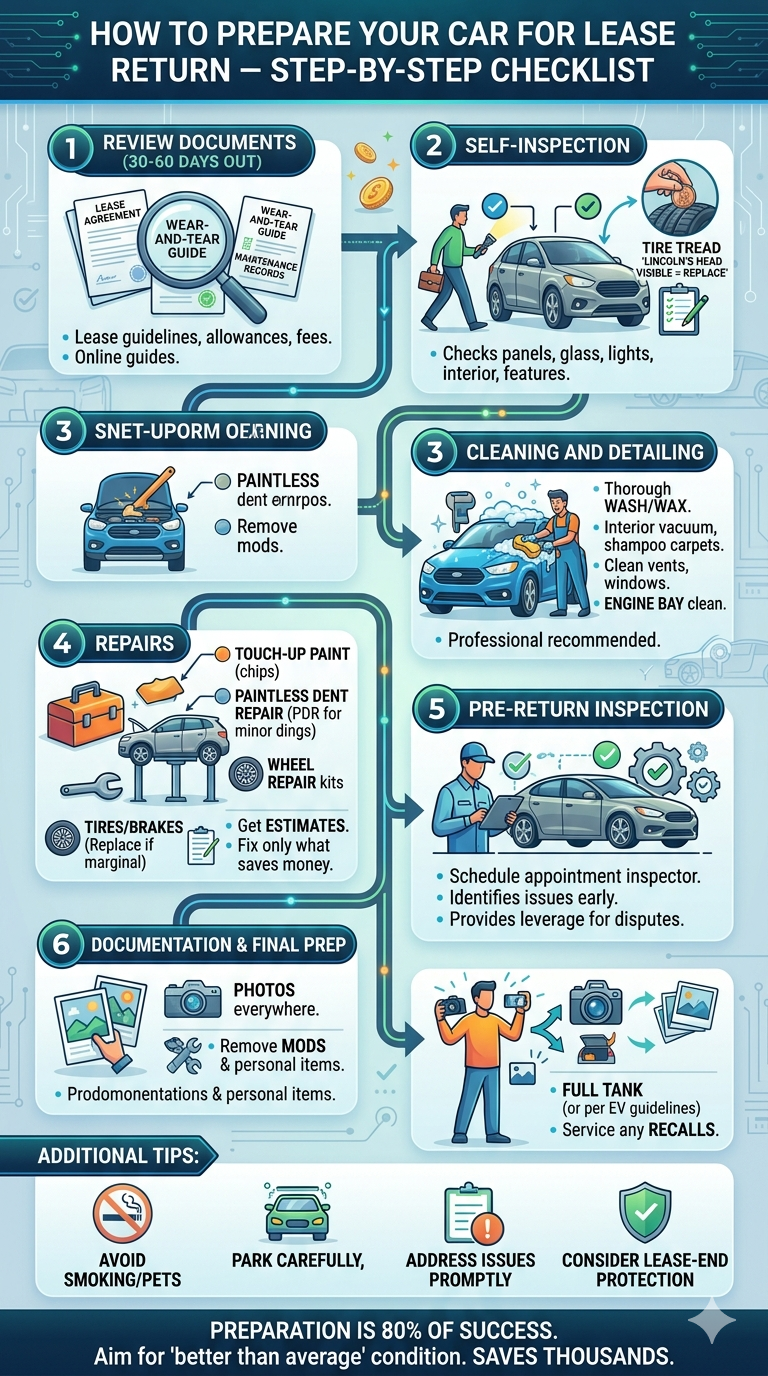
Step 1: Review Documents (30–60 Days Out)
- Lease agreement: Note exact guidelines, allowances, and fees.
- Wear-and-tear guide (often provided or online).
- Maintenance records.
Step 2: Self-Inspection
- Walk around exterior in good lighting.
- Check all panels, glass, lights, tires (tread with penny test: Lincoln's head visible = replace).
- Interior: Seats, carpets, trunk, odors.
- Test all features (lights, wipers, AC, infotainment, EV charging).
Step 3: Cleaning and Detailing
- Thorough wash/wax.
- Interior vacuum, shampoo carpets/seats, condition leather, clean vents/windows.
- Engine bay clean (if applicable).
- Professional detailing recommended for best results.
Step 4: Repairs
- DIY/Cost-Effective: Touch-up paint for chips, paintless dent repair (PDR) for minor dings ($50–$150 vs. hundreds in charges), wheel repair kits or pro service.
- Tires/Brakes: Replace if marginal—cheaper proactively.
- Avoid cheap fixes; inspectors spot poor-quality repairs and charge more.
- Get estimates; fix only what saves money vs. paying the fee.
Step 5: Pre-Return Inspection
- Schedule with dealer or independent service (some free or low-cost).
- Identifies issues early for targeted fixes.
- Provides leverage for disputes.
Step 6: Documentation and Final Prep
- Photos everywhere.
- Remove mods, personal items.
- Full tank (or per EV guidelines).
- Service any recalls.
Additional Tips:
- Avoid smoking/pets if possible (odors persist).
- Park carefully; use touchless washes.
- Address issues promptly during the lease.
- Consider lease-end protection add-ons if buying new (covers up to $5k–$10k wear).
Following this can save thousands. Many report zero or minimal charges with preparation.
How Eagle Star Detail Can Help

Professional detailing transforms a vehicle from "lived-in" to "showroom-ready," directly addressing many common charge triggers like dirt, swirls, stains, and minor imperfections. Eagle Star Detail, a premium mobile service in the Boise, Idaho/Treasure Valley area, specializes in this.
Services Relevant to Lease Returns:
- Full Auto Detailing: Comprehensive interior/exterior cleaning. Removes stains, odors, restores carpets/leather, polishes exterior.
- Paint Correction: Removes swirls, scratches in clear coat, oxidation. Brings paint to high-gloss, hiding or minimizing minor imperfections inspectors notice.
- Ceramic Coating: Long-term protection (2–3 years, 5 years, or lifetime options). Enhances gloss, adds hydrophobic properties, protects against damage.
- Wheel & Tire Restoration: Cleans brake dust, repairs minor rash.
- Mobile Convenience: Service comes to you—home, office, or storage—in Boise, Meridian, Eagle, Nampa, etc.
Benefits for Lease Return:
- Cost Savings: A $300–$800 detail often prevents $1,000+ in charges for "excess dirt/stains" or dull paint.
- Inspection-Ready Finish: Inspectors are more lenient on pristine vehicles. Deep cleaning makes small issues less noticeable.
- Expert Assessment: Detailers can spot and advise on fixable issues (e.g., PDR referrals).
- Protection: Ceramic adds value and ease of maintenance during the final weeks.
Contact Eagle Star Detail for a quote tailored to your lease timeline. Schedule early, as availability can be limited.
Manufacturer Comparison
Policies vary significantly by manufacturer. Luxury brands are often stricter; mass-market more forgiving with waivers. Always verify current terms with your leasing company.
Ford (Ford Credit)
- Normal wear: Up to 3 dings/dents per panel (<4 inches), limited interior stains/burns.
- Tires: No sidewall damage/exposed cords.
- Disposition fee: Often waivable with new Ford/Lincoln.
- Protection: WearCare® option covers up to $5,000.
Audi (Luxury German)
- Standard: Stricter on appearance. Scratches/dents <2 inches, ≤3 dings per panel.
- Protection: Lease-End Protection (up to $10,000 waiver on wear/mileage).
- Focus: Premium finish; curb rash and paint chips scrutinized.
Honda (Mass-Market Japanese)
- Leniency: $500 Excessive Wear and Use Waiver (up to $1,000 for loyal customers with new lease).
- Mileage: Lower penalties (~$0.15–$0.20/mile).
- Good for: Budget-conscious lessees who want more forgiving policies.
Tesla
- Process: Photo-based self-inspection + final review.
- Standards: Few small dings/chips/scratches normal. Strict on modifications (must remove tint/wraps/non-factory wheels).
- Mileage: $0.25/mile overage (higher than others).
- EV-Specific: Battery/charging port checks.
| Category | Ford | Audi | Honda | Tesla |
|---|---|---|---|---|
| Normal Dents | ≤3/panel <4" | ≤3/panel <2" | Up to waiver | Few small |
| Tire Requirement | Matching, no damage | High scrutiny | Matching, waiver helps | Matching, tread |
| Mileage Penalty | ~$0.20/mile | Higher | ~$0.15-0.20/mile | $0.25/mile |
| Waivers/Protection | WearCare $5k | Up to $10k | $500–$1k | Loyalty credits |
Advanced Strategies and Common Pitfalls
Pitfalls to Avoid:
- Procrastination—last-minute fixes are rushed/expensive.
- Assuming "normal use" covers everything.
- Ignoring odors or deep stains.
- Forgetting keys/spare.
- Not documenting condition with photos/video.
Dispute Process:
- Review inspection report carefully.
- Provide your photos/evidence.
- Negotiate (many charges are adjustable).
- State consumer protection laws or arbitration clauses in lease.
- Independent appraisal if allowed.
Alternatives to Return:
- Buyout: Often avoids disposition/wear if negotiated.
- Trade-in: Dealer may absorb some fees.
- Extension: Rare, but worth asking.
For High-Mileage or Rough-Use Drivers:
Strongly consider wear protection or plan to buy out the vehicle to avoid excessive charges.
Final Checklist and Conclusion
A successful lease return requires knowledge, preparation, and proactive action. By understanding inspector criteria, preparing thoroughly (including professional help from services like Eagle Star Detail), and knowing brand nuances, you can avoid thousands in fees and end your lease confidently.
Final 30-Day Checklist:
Expect the process to go smoothly with this approach. For personalized advice, consult your dealer or leasing company. Safe driving, and enjoy your next adventure on the road!
This guide is for informational purposes. Policies change—verify current terms with your leasing company. Word count: Approximately 4,200.
Ready to Prepare Your Vehicle for Lease Return?
Eagle Star Detail can help transform your vehicle to showroom condition, protecting you from unnecessary fees.